Saturday, April 23, 2011
What's Next for the Oil Risk Premium?
Thursday, April 21, 2011
What I'm Reading...4/21/11
Happy Thursday.
"A green future will result not from subsidizing immature technology today but from developing competitive green technology that is effective and cheap. Wind and solar power are not yet competitive. Research would be a much better investment for Western countries than subsidizing imports of today’s green technology from China."
Well put. It reminds me of another report I read today (admittedly- only skimmed) that discusses the failure of the Climate Action Partnership to successfully push climate action despite out-fundraising conservative advocacy organizations 11 to 1 (and outspending on climate change related projects 44 to 1). I haven't had the time to go through it in full yet (its probably 100 pages long), but looks very interesting (ClimateShift "Clear Vision for the Next Decade of Public Debate").
Saturday, April 16, 2011
China moves up the value chain
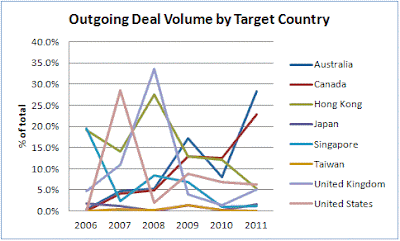
According to Dealogic, outbound Chinese M&A has totaled $24bn year-to-date. If this level of activity were to continue for the rest of the year, total 2011 outbound M&A by Chinese companies could reach $100bn, almost double 2010 numbers.
The overarching trend of the last 5 years has been an increased focus on natural resources companies. Outbound acquisitions by Chinese companies targeting the mining space have increased from 6% of total deal volume in 2006 to 34% in 2011 YTD. Oil & Gas has accounted for 30-40% of total outbound M&A volume for the last three years.
To what extent can we expect these trends to continue? As long as state-owned Chinese companies have a mandate to secure resources, we can expect cross-border mining and oil & gas activity to make up the vast majority of deals. But the massive surge in natural resources focused activity masks other equally important trends.
Friday, October 15, 2010
Strongest quarter for LBOs since the credit crash
Monday, October 11, 2010
Bain's LBO of Gymboree looks like a slam dunk
Monday, October 4, 2010
What Sara Lee tells us about the current LBO environment
About a month ago, KKR allegedly offered to buy Sara Lee for $12B, though Sara Lee's board spurned the buyout firm's advances. It's easy to see why Sara Lee might be an attractive LBO target -- it's not too leveraged, has strong brands and significant opportunities for operational improvements. My analysis (see below) shows that KKR could reasonably expect double-digit returns even if sales growth remains low. So why has KKR not raised its bid or gone hostile?
Given whats happened in the markets we should expect a sharp increase in sponsor activity. The financing market is in great shape and vintage 2005-2008 funds are flush with capital. LBO activity is in fact rebounding as total YTD sponsor backed deals are almost back up to 2005 and 2008 levels. And yet as conditions have improved, we still haven't seen the $10 billion plus mega deals that were the norm before the crisis.
According to Prequin surveys, a majority of LPs are reconsidering their allocation to large PE funds with some notable firms like Blackstone even returning previously paid fees. Now, with PE fundraising still weak, buyout firms are under pressure to prove their mega LBOs generate superior returns and deserve management fees of 1% or higher. The deals done today may prove to be critically important to securing funding in the future.
My analysis below shows that, although Sara Lee is an attractive LBO at $12B, those returns quickly disintegrate as price increases. In fact, price is more important to generating a return (on a percentage basis) than cost of debt or EBITDA growth.
The model below can also be downloaded as an excel file here. The operating model uses historicals to project EBITDA growth and Cash Flow / EBITDA.
Sara Lee Analysis
Monday, September 27, 2010
3G LBO of Burger King
3G's $3.3B ($4.17B total transaction value) LBO of Burger King is one of the most high-profile LBOs of 2010. This LBO is interesting for a number of reasons. For one, the acquirer, investment fund 3G (funded by a small group of Latin American billionaires), is not a part of the usual suspects one would expect to see on a deal of this magnitude. Also different from most LBOs, 3G has stated it is buying Burger King for the long-haul and is willing to wait 10 years before exiting.
The choice of Burger King is also a strange one. When BK was bought out by Bain, GS, and TPG in 2002, Burger King was an insignificant and unappreciated holding of the food and beverage behemoth Diageo, allowing the sponsors to acquire BK at a very favorable valuation. But the Burger King of today is much different. Eight years of sponsor ownership have turned BK into a lean company with few easily realized cost reductions. Furthermore, from a strategic point of view, BK has fallen far behind its rival McDonald's and requires massive amounts of capital expenditures to compete (estimated in a recent Bloomberg article to be as high as $3 billion). For more on the challenges facing 3G, go here. Perhaps most surprising is the valuation. 3G did not pick up BKC on the cheap, paying 9.4x LTM EBITDA and 8x LTM net income.
My model of the LBO is posted below. I suggest you do not try to look at it on Scribd but instead go here, and download the excel file. My analysis shows that using conservative growth assumptions and moderate cost cutting assumptions, the Burger King LBO could return 16% annually if 3G exits in five years at the same valuation (9.4x EV/EBITDA) at which it entered.
However, this return is very sensitive to Burger King's ability to cut costs, which is questionable given the rising costs in the industry as well as BKC's previous ownership (Management also expects SG&A to increase by 3% in 2011). If one assumes Burger King has to boost capex to 10% of sales and SG&A as a % of sales increases by 3%, the 15% IRR quickly disappears, even with above trend top-line growth.
That being said, I actually think this deal was a good idea for 3G if 3G manages to leverage its experience in Latin America to grow Burger King quickly in emerging markets. As Burger King grows internationally, its operating leverage from its restaurant ownership will deliver larger margins and significantly increase Burger King's valuation. But overall, like most recent LBOs, the success of the BKC LBO is heavily dependent on exogenous forces. 3G is blessed to have patient investors. It's longer term investment horizon will allow it to wait for an opportune time to exit -- which can make all the difference.
Burger King LBO Model