Showing posts with label China. Show all posts

Saturday, April 16, 2011

China moves up the value chain

According to Dealogic, outbound Chinese M&A has totaled $24bn year-to-date. If this level of activity were to continue for the rest of the year, total 2011 outbound M&A by Chinese companies could reach $100bn, almost double 2010 numbers.

The overarching trend of the last 5 years has been an increased focus on natural resources companies. Outbound acquisitions by Chinese companies targeting the mining space have increased from 6% of total deal volume in 2006 to 34% in 2011 YTD. Oil & Gas has accounted for 30-40% of total outbound M&A volume for the last three years.


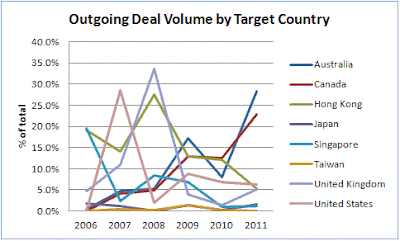
This trend is also reflected in the target countries with resource-rich Australia and Canada recently becoming the most targeted countries.


To what extent can we expect these trends to continue? As long as state-owned Chinese companies have a mandate to secure resources, we can expect cross-border mining and oil & gas activity to make up the vast majority of deals. But the massive surge in natural resources focused activity masks other equally important trends.

Recently, Chinese outbound M&A targeting higher value sectors has ticked up markedly. M&A targeting Healthcare companies is up from $0mm and $253mm in 2006 and 2007 to $603mm and $204mm in 2010 and 2011 YTD, respectively. On an annualized basis, the number of transactions targeting Healthcare outbound Chinese M&A is up 400% from 2007. Almost all of this activity has targeted the pharmaceutical or instruments sector within the Healthcare industry, which are significantly higher-value sectors than other verticals within Healthcare such as the care or products verticals.

M&A targeting computer & electronics companies has also increased significantly. Deal volume targeting these companies totaled $1,326mm last year (34 deals) compared to $406mm (12 deals) in 2006. If 2011 activity continues at its current pace, total 2011 deal volume could reach $2,000mm.

Though these increases can't compare with the increase in natural resources focused activity, in some ways these trends are more important. The amount of Chinese M&A targeting higher value-added sectors such as pharma and electronics is a valuable datapoint to tracking the nature of China's economic development. It is only logical that over time Chinese industry will increase its presence in higher value-added industries currently dominated by Western and Japanese/Korean companies. What might be surprising, however, is the pace at which this is already happening.

Note: my Dealogic dataset includes all announced M&A by Chinese companies where the target nationality is not Chinese.

Monday, December 28, 2009

Chinese Banking Strength

Chinese banks' non-performing loan ratio dropped from 2.42% in January 2009 to 1.66% at the end of Q3 2009. In contrast, Western banks have steadily increased loan-loss reserves. Some (such as Tony Wang and Grace Tian of ChinaKnowledge) have pointed to this change as proof that the Chinese banking sector has grown stronger during the financial crisis and is well situated to expand abroad.

Tuesday, November 17, 2009

Obama in China

At first, it seemed like Obama's visit to China might actually be fruitful after the People's Bank of China issued a report promising an improvement in the yuan's exchange rate mechanism a few days before Obama's arrival. But this move was posturing, an attempt to lessen discussion on this topic and not a sign of coming compromise.

Monday, November 9, 2009

Updates: China's Yuan Policy and Bubbles

Two news articles caught my attention this morning because they relate strongly to what I have written about recently on this blog.

Tuesday, November 3, 2009

China: "Give Me Balanced Trade, Just Not Yet"

China's repegging to the dollar is critically important to global trade. It gives China a free lunch: not only are China's exports protected by the US dollar's decline, they will increase as the yuan declines relative to other currencies.

Harvard economist Jeffrey Frankel uses regression analysis to determine China's yuan policy. His research shows that in 2005, Beijing de-pegged from the dollar and re-pegged to a basket of the dollar and the euro. According to Frankel, the 20% appreciation of the RMB from 2005 to 2008 was a reflection of the euro's rise against the dollar. Recently, the Chinese have moved back to a dollar peg. Frankel said that "during the most recent period, September 2008-February 2009, all the weight has once again fallen on the US currency. The regime has come full circle, virtually back to what it was in late 2005."

Friday, October 9, 2009

Weak Dollar Will Normalize Trade Imbalances and Unemployment

The best recent policy response to the financial crisis didn't come from the G20 but from the foreign exchange market. This week the dollar fell aggressively against many currencies, driven by an Australian rate increase and a report claiming Arabs, Chinese, and Russians were conspiring to stop pricing oil in dollars. But the dollar was set to depreciate anyway due to an increasing debt and a dovish Federal Reserve. A weak dollar will have a positive effect on normalizing trade imbalances, if it lasts.

A falling dollar is a great stimulus to the US manufacturing base. Historically, manufacturing profits are inversely related to the value of the dollar.

From 1990 to 1995, the dollar stayed around the same level. But in 1995, the dollar started rising steadily, eventually peaking in 2002 after rising 51%. During this time, exports decreased by half:
During this period, exports in China and Japan surged. China's reserves quadrupled and Japan's reserves almost tripled. (For more information, see Robert Blecker's paper, "The Benefits of a Weak Dollar" at the Economic Policy Institute.) The strong dollar also had a large effect on jobs. See this figure on the effect of China's artificially low currency on employment and trade:

The map below shows the damage per state (see Robert Scott's paper here). Note that politically sensitive states such as Ohio, Michigan, and Florida have suffered some of the biggest losses.
Simon Johnson from MIT wrote a recent article arguing the weaker dollar is a part of Obama's plan to win the midterm elections by stimulating the manufacturing industry. Simon says NY Fed President William Dudley's recent comment that interest rates would stay low for the foreseeable comment was timed to send the dollar lower after the Australian rate hike. If rates stay low in the US for longer than other countries, there is an opportunity for a carry trade between the dollar and a currency that is likely to increase rates sooner (e.g. Korea, Australia, China or Switzerland).

Fundamentally, the dollar has nowhere to go but down. With high fiscal debt, loose monetary policy, and trade deficits, the dollar is fundamentally unattractive. Furthermore, there is likely to be significantly less demand for dollars in the future. The second largest holder of US debt, Japan, is highly indebted (debt to GDP of 170%) and aging. The savings rate has been steadily decreasing and will continue to reduce demand. Furthermore, the number one holder of US debt, China, is actively (and publicly) trying to diversify from the dollar.

But while the dollar may go down and start to normalize trade in the short-term, there is reason to be skeptical that this will occur for longer periods of time. Asian nations will not let the dollar get too low. Already we have seen Asian countries respond to the falling dollar. Yesterday, the FT reported Asian central banks aggressively bought the dollar on Thursday. Thailand, Malaysia, Taiwan, Hong Kong, and Singapore made substantial purchases, though they merely slowed the dollar's decline. A key aspect of this intervention was that it was coordinated.

The Asian countries that intervened likely did so primarily to stay competitive with China, which re-pegged the renminbi to the dollar in July 2009. This re-pegging of the renminbi means that whenever the dollar significantly weakens, a large number of central banks must intervene if they want to compete with China. This could mean a floor for the dollar. It could also be a bullish indicator for US treasuries, as foreign central banks may buy treasuries to push the dollar higher.

Friday, September 18, 2009

Iran Incongruities

As the world inches closer to official and non-official deadlines given to Iran on nuclear negotiations, something in the international equation just doesn’t add up.

The relevant players here are the P5+1 (the permanent five members of the UN Security Council plus Germany), Israel, the Sunni gulf states, and Iran. It’s worth evaluating their interests one by one, since a composite view of the situation will involve an intersection of these interests with their respective capabilities.

China—not thrilled about the prospective of nuclear proliferation, but even less thrilled about the prospect of interruptions in its energy supplies. China imports almost 60% of its oil from the Persian Gulf, and its largest trading partner is Iran. This means that the odds of China agreeing to the only sanctions that would really hit home in Iran—a gasoline embargo—are slim to none, since economic weakness directly translates to innerpolitical turmoil and trouble for the Communist Party. The only worse prospect is armed conflict, which would almost certainly close off the Straits of Hormuz entirely.

France—Sarkozy has been clear that France will not tolerate a nuclear-armed Tehran. Iran’s numerous and continuing infringements against UN resolutions give the administration a legal basis to an increasingly militant posture.

The UK—in line with France and the US. Will not tolerate a nuclear-armed Iran, but like both countries, would prefer to avoid commitment of armed forces (for obvious reasons of economic and political costs and risks).

Germany—Germany is in a much more conflicted position than some of the government’s rhetoric would lead one to believe. For one, Germany (and close relative Austria) has substantial commercial interests in Iran. Secondly, although people and government are publicly very anti-nuclear-proliferation, both distrust US leadership, and have absolutely zero appetite for any type of conflict anywhere in the world, let alone in the neighborhood of Iraq, which is widely viewed as a symbol for All That is Wrong With America. The Germans have a tendency to view all conflict as fundamentally driven by self-interest, which is therefore intrinsically immoral (unless Germany’s own interests are at stake). Finally, Germany’s increasingly cozy relationship with Russia, borne both from energy dependence and diverging interests with the US, means that Germany is unlikely to form a united front with the rest of the West to exert pressure on the other stakeholders in the brewing conflict.

Russia—Russia already has extensive commercial ties with Iran, specifically in two sensitive and lucrative sectors: nuclear technology (the Buschehr plant) and armaments (particularly SU-300 SAMs). The country therefore has a vested interest in business-as-usual, except that the alternative (strict sanctions or war) have a potential to be even better for the Kremlin’s bottom line. A closing of the Straits of Hormuz would lead to an explosion in oil prices, and gasoline sanctions would allow Russia to make a killing exporting fuel overland to Iran at inflated prices. Even more importantly, Russia would like to see nothing more than to see the Middle East suck in American resources even further, since this would allow it to continue reasserting control over its sphere of influence in the former Soviet Union (particularly Ukraine and the Caucasus). The only balancing aspects are that Russia is also interested in a stable Afghanistan, meaning that a shift in US combat capabilities out of the country would require added expenses by the Kremlin to secure that border; and secondly, a nuclear-armed Iran will likely further push US ballistic missile defense system proliferation in Eastern Europe. News that the US has shelved these plans, whether true or not or for whatever reason, do not change that long-term reality. Overall, though, between its oil export capability, potential to disrupt American air attacks by the dissemination of air defense systems, and even nuclear support, Russia can make a difficult situation just that much worse.

The US—the US doesn’t really want war, and can’t afford it. The latter is not just a matter of defense appropriations and budget deficits, but also opportunity costs and the deep socioeconomic malaise that would follow the inevitable rise in crude prices following Persian Gulf action. However, the US cannot tolerate a nuclear-armed Iran, for the following reasons: 1) it is illegal under the NPT and would weaken the international state system, 2) it would constitute an existential threat to all US allies in the region, particularly Israel; 3) it could very well lead to an arms race in the Middle East that harbors immense fat-tail risks. Finally, Obama is seen internationally as young, untested, and possibly weak, and he is a Democrat, which means that at the domestic level he must constantly prove his foreign-policy steel. He cannot afford to appear even slightly weak here.

The Gulf States—America’s Sunni allies in the Persian Gulf, and chiefly Saudi Arabia, are extremely concerned about the prospect of nuclear armament in the region and its potential to shift the balance of power. Many battle with social issues around the integration of Shiite minorities within their own borders. The question, as always, is not only one of capability, but of political will—how to balance their populations’ antipathy to everything Israeli with the confluence in national interest? As is the case with Palestinian support, rhetoric will sharply diverge from policy.

Israel—has made its position abundantly clear: Iran will not be allowed to acquire nuclear weapons. Netanyahu is playing a complicated political game balancing domestic and international politics (best shown in settlements ‘freeze’). In recent weeks, he has tried to buy the Russians, cajole the Americans, intimidate the Iranians, and ratchet up the pressure as much as possible. To mount an attack across Iraqi/ American airspace, Jerusalem needs Washington’s approval. But the wild card here is Obama’s perceived coolness to the Israeli cause—if the Israelis do not predict help as forthcoming, they may feel freed to undertake radical action themselves.

Iran—is playing the usual games. They are attempting (and succeeding) and changing the debate from revolving around nuclear issues, to revolving around the debate itself. They have done this by proclaiming first that nuclear issues are not on the table during the upcoming negotiations (scoring domestic political points and adding another hurdle for foreign diplomats), then proposing Tehran as the negotiation site (which is impossible, since negotiations are at head-of-state level, but would be a major victory if agreed upon), by making small meaningless concessions. (such as letting inspectors back into an enrichment plan), and finally, by releasing a position paper. The last bit allows the more recalcitrant participants (Germany, Russia, China) to claim that diplomacy is making progress and thus oppose stricter sanctions, when really the situation has not changed at all. The hoped-for outcome is that, after a year of meetings, all players go home exhausted, and with even fewer options than before.

The point is, everyone has very different priorities, and everyone is trying to push the situation as far as possible thinking no one else will act. For example, no one thinks Israel will act without US support, and no one thinks the US will (or can) act at all; but these assumptions don’t necessarily hold true. Expecting a few months of negotiation with no tangible outcome simply does not make sense when some players simply cannot afford to let that happen at almost any cost (particularly Israel and the Arabs). Also, Obama is thinking of Kennedy and the Cuban missile crisis, and has a strong incentive to move fast. With so many miscalculations and moving pieces, the situation could escalate rather quickly.

There are a few possible accommodations that could be made to change the constellation of players. The most intriguing is a Grand Bargain between Russia and the US (of which the recent US scrapping of missile defense systems may well have been the starting gun). It would really cost the US, above all in credibility, since it would basically have to withdraw support from Georgia, the pro-western sections of Ukraine, and even to some extent Poland, and lessen its presence in Central Asia; but policymakers might well decide that this is worth it since n the long-term, these losses can be regained. If the West were truly unified—Germany being the problem here, not France—then this would be more easily achievable, since Russia would both see a bigger stick waving and could be offered more carrots.

Another possibility is a massive change in US strategy. It would take a while to implement because of the formidable logistical obstacles, but the US could shift forces right back out of Afghanistan into the Gulf region, abandon the Afghan effort altogether (thereby creating a liability for Russians), to ratchet up pressure on Iran and signal a willingness to fight.

A wild-card here, ignored in most discussions, is China. How would the Middle Kingdom react to military action in the Gulf that reduces oil imports or raises their price? For that matter, could the country be convinced to support sanctions if the only alternative is war (which would be even worse economically)? The Chinese talk like a superpower, but haven’t paid the costs yet—maybe they will begin to here?

In any case, no matter what pattern of escalation follows between Iran and the West, or Russia and the US, or whichever constellation of powers, nuclear war is not the risk. But the odds of an economic disruption of some sort are rising with every day that there is not a realignment of the interests described above. And thus, it might well make sense for investors to hedge what could be a substantial fat-tail risk. In almost any scenario, crude oil and Russian indices should do well, and the US (and most of the rest of the global economy) should do relatively worse. Alternative energies would get a boost. And given that the popular media coverage of the situation has been muted thus far, this kind of protection should still be affordable.


Special thanks to my brother (who knows much more about geopolitics than I) for his input into this article. This article is a product of a long phone conversation with him, and the ideas in it should be considered his more than mine.

Wednesday, September 16, 2009

Perspectives on Obama's Tire Tariff

Pres. Obama's recent 35% tax (on top of an existing 4% tariff) on tires imported from China has generally been denounced as a protectionist move motivated by domestic political factors. Bill Witherill of Cumberland Advisors called it a "cynical and dangerous move" because the US tire manufacturing industry is internationally uncompetitive anyway. Some have speculated the tariff will lead to another Smoot-Hawley effect on the world economy. With the lessons from the Great Depression hanging heavy over everyone's head, the recent trend of trade retaliation (such as competing Buy America and Buy China policies) is certainly alarming.


But while the tariff may seem ominous from an economic perspective, from a geopolitical perspective the tariff makes more sense. A recent article from Stratfor (which is unfortunately not public) argues the moves of both countries were politically motivated and are unlikely to escalate. I don't agree, but it's an interesting argument. First they point out this is not a normal WTO case, because Obama never even mentioned any unfair trade practices. Obama did it because he can. In the 2001 Chinese WTO accession agreement, Clinton insisted on including a particular section 421, which basically allows the US to sanction any product without making a case for trade violations until the end of 2013. For that reason, China cannot react in any way that will actually hurt the US, because it could provoke Obama to use section 421 again, completely legally. We have yet to see any meaningful retaliation. China declared it would probe "unfair practices" in US chicken and auto products, but that's it.

But why would Obama do this for domestic political reasons as the FT, WSJ, Stratfor, and others have claimed? Sure he's having trouble with healthcare, but why would he trade a small boost in his base for further complications in Iran? As Stratfor points out, China could easily retaliate by refusing to cooperate with sanctions or stonewalling negotiations. But this would make Obama look terrible. Obama has a lot of political capital riding on Iran. His criticism of Bush's unipolar attitude and unwillingness to negotiate was one of his main foreign policy selling points during the campaign. I think its more likely Obama enacted the duty to remind China of its economic leverage before the P5+1 negotiations with Iran. China is not enthused about sanctioning its third-largest supplier of oil.

Obama said on Wall Street this Monday,
"Make no mistake, this administration is committed to pursuing expanded trade and new trade agreements. It is absolutely essential to our economic system. But no trading system will work if we fail to enforce our trade agreements. So when, as happened this weekend, we invoke provisions of existing agreements, we do so not to be provocative or to promote self-defeating protectionism. We do so because enforcing trade agreements is part and parcel of maintaining an open and free trading system."
These words imply the US sees its ability to tariff-at-will as a right in return for opening up trade with China. While his choice of industry might have been politically motivated, his decision to raise tariffs in the first place was likely a geopolitical one. It will be interesting to see how the trade and Iran issues evolve alongside each other.

Tuesday, September 8, 2009

Negotiating with Iran

In a press conference yesterday, Iranian President Ahmadinejad ruled out compromising on Iran's "undeniable right" to a nuclear program but stated he is open for discussion with Pres. Obama. This statement indicates the challenges facing President Obama's Iranian policy. Obama campaigned on the premise that he could talk to antagonistic leaders without preconditions and achieve multipolar solutions. But that is virtually impossible as long as Ahmadinejad is president of Iran.


As long as Obama follows a multi-polar strategy, Iran will be able to delay by playing members of the engagement against each other. Consider the deadline set by Obama for Iran to come to the negotiating table, which is less than three weeks away. If Iran refuses to talk, the G-8 has promised "crippling sanctions." The delegation that will negotiate with Iran consists of the UN security council plus Germany (US, UK, France, Germany, Russia, and China). The UK, France, and Germany can be expected to follow Obama's lead. But Russia and China care much less about a nuclear Iran than the US. Moreover, Russia and China have a significant stake in keeping Iran stable and gain nothing from sanctions. It is in Russia's interest to keep the US occupied in the Middle East and away from its periphery. Russia also trades with Iran and will want to protect this. China depends on Iran for commodities. As long as Iran is China's third largest oil supplier, China will not be willing to get tough on Iran while Iran maintains a semblance of co-operation.

Ahmadinejad has taken advantage of this division. His recent statements were vague enough for Russia and China to claim Iran is willing to negotiate, drawing the process out further. Ahmadinejad also notably invited leaders from these countries to Tehran, something Obama is unlikely to do for domestic political reasons. If parties can't degree on where to meet to negotiate, the negotiations are likely to be just as unproductive.

On the other hand, Obama has no alternative to a multi-polar strategy. Sanctions can only be effective if Russia and China participate. The US simply has little leverage over Iran, having exhausted most of its options in the past. Whatever happens in Iran will ultimately depend on Russia and China.

Sunday, July 26, 2009

China: Turning Reserve Imbalances into Real Assets

This week, China revealed to the world what it already knew: China is using its foreign exchange reserves to fund foreign acquisitions by state-owned industrial giants. Premier Wen Jiabao said on Tuesday, "We should hasten the implementation of our ‘going out’ strategy and combine the utilization of foreign exchange reserves with the 'going out' of our enterprises." The "going out" refers to the efforts of large Chinese companies, such as Sinopec, Chinalco, and the Bank of China, to acquire foreign counterparts. However, the investment targets are no longer stakes in temporarily weakened western entities, but companies that will secure access to raw materials and energy.

Considering recent acquisitions (or acquisition attempts), this strategy has been obvious for quite some time. But it is a milestone to have a Chinese official publicly acknowledging the "going out" strategy for the first time. Jiabao's statements are also further recognition of China's dissatisfaction with the US dollar. This dissatisfaction has steadily increased and, over the past month, China has tried different avenues to address its reliance and vulnerability to the US dollar.

Early in July, China called for the G8 to discuss an alternative global reserve currency. Around this time, it also announced it would allow select Chinese companies to settle transactions in renminbi. A statement from the People's Bank of China stated, "Companies in China and neighbouring countries are facing relatively large risks of exchange-rate fluctuations because of big swings in the US dollar, the euro and other major currencies used for settlements." China's "going out" strategy is another way to address its reliance on the dollar. As the FT's John Authors pointed out in "the Short View" on July 23rd, China's strategy has shifted slightly from buying commodities to buying the companies that produce commodities. This is a good investment strategy as the rebound in commodity-based equities has far outstripped the rise in commodities. But there is also a strategic advantage: being a producer gives China more pricing power than being the biggest buyer. One interesting thing to watch in the future is what happens to the size of the "China premium", or the extra amount Chinese companies often have to pay to acquire foreign companies.

The "going out" strategy is also reflective of China's new geopolitical role. China's involvement abroad is based on trade rather than principles and politics. Its "going out" strategy means China will be a bigger player in places like Africa and Central Asia where there are abundant resources but less political opposition than places like Australia, where public opinion effectively blocked the 19.5bn Chinalco-Rio Tinto investment. In this sense, China is leveraging its currency differences in two ways. First, the low value of the renminbi drives export-oriented industries to China. Secondly, the suppressed renminbi supplies China with large reserves, which it now translates into real assets. The "going out" strategy, as well as China's efforts to have some Chinese companies use the renminbi, underscores that a weakening dollar will remain one of the strongest secular trends over the next decade. That is, unless there are stark structural changes in the US economy, which seems increasingly unlikely as appetite for reform is slowly seeping out of the political consciousness (best seen in the rising opposition to cap-and-trade and healthcare reform).

Tuesday, April 28, 2009

China's Gold

Needless to say, throughout the turmoil of the last year, the forecasts for most asset classes have been bearish. However, many speculators have been bullish on China and gold, largely because of what’s happening in the rest of the world. Indeed, many of those who predicted the crash—such as Jim Rogers and Peter Schiff—argue China and Gold are the only safe assets to hold over the next couple years. Maybe the futures of these two are more related than it seems.


China seems to be doing great. The latest economic figures on housing, auto sales, and commodities are quite good. Goldman Sachs recently upgraded growth forecasts for 2009 to 8.3% from 6% and, for 2010, to 10.9% from 9%. And, best of all, new loans in March were 29.8% higher than a year earlier!


I wrote in my last post on the question whether, “horses will drink,” a reference to the question whether increasing the money supply will increase the velocity of money. China doesn’t have that problem. While the US can encourage banks to lend and use TARP money to make loans (most haven’t), China only needs to say the word, and it’s done—one of the benefits of an authoritarian government.


But is this really a benefit? It seems so in the short run, but in the long run it can mean losses from sloppy lending, especially in a country with crony capitalism. A lot therefore depends on the much-asked question whether China can survive without strong exports. Economists are divided on the issue. There is data that shows only 8% of China’s workforce is involved in export industries. Either way, it is hard to imagine how China could keep up its growth without external demand and capital at current levels of domestic spending. For that reason, much depends on Chinese consumer spending. James Kynge wrote in his famous book China Shakes the World in early 2006 that Chinese consumer spending should “hit us in two or three years.” The world, as well as the largest shopping mall in the world in Dongguan—nearly empty, is still waiting.


People’s Bank of China governor Zhou Xiaochuan recently gave a speech on China’s “superior system advantage.” In it he argued the country’s low interest rates, stimulus, and new medical system will boost domestic spending and bring China, and the world, out of recession. The health service plan is seen as a key part of boosting consumption. Chinese generally save at much higher rates than the rest of the world. Many think the higher savings rate is a result of uncertainty about the future, and that a social safety net would greatly increase consumer spending. While this may be so, China’s new health care system will not function for many, many years. So of these three variables Zhou Xiaochuan mentioned, only one has a substantial effect of raising consumer demand and it will not be in effect for years.


The government must, therefore, rely on itself. It must spend its way to economic growth, and though its reserves are vast, it may be more limited than it seems. Zhou Xiaochuan has been in the news recently after calling for a new reserve currency from the IMF, echoing Premier Wen Jiabao’s call for guarantees on China’s dollar holdings. And for good reason: China is in a sticky situation with its dollar assets. In the short term, selling treasuries would drive down the price of treasuries, raising interest rates and hurt Chinese exports even more by raising the value of its currency. In the long term, inflation in the US could wipe out their value. China is treading a thin line between stimulating its consumers and hurting its exports. For that reason, China needs a new reserve strategy.

One option is gold. In fact, the FT reported a few days ago China’s gold reserves had jumped drastically to 1,054 metric tons. The dramatic shift is evident in the graph below, which is from before its acquisitions were public. China's true holdings should be around those of Switzerland.


Of course, gold could never replace the dollar as China’s main reserve asset. China is a lot more important to gold than gold is to China. Gold has been struggling to stay high after the fear frenzy of the stock market crash burned down. If China decides to put more emphasis on gold, which is likely considering its problem of holding too many dollars, gold could rise above $1,000 per oz, much like China did for copper earlier this year.