The dollar's status as the world's reserve currency is not necessarily the exorbitant privilege it's often described, especially not when facing growth-threatening fiscal deficits and sluggish industrial growth. When one looks at the dramatic need for growth in the US, the status as world reserve currency becomes much more expensive.
Recent news in China and the US underscores the difficulties of the current system, which even after an economic crisis is still structurally the same as before. In China, inflation is increasing (see for example China's recent fine of Unilever) while in the US, GDP growth has slowed to 1.8%. The difference between now and the last cycle is that US consumers have been sucked dry. The US consumer can no longer drive demand. The good news is that the middle class in China, India, Brazil, etc. is growing incredibly fast, driving increases in consumerism and urbanization. The bad news is that as long as the Dollar is the world reserve-currency it will be difficult to realize the full potential of this enormous opportunity. The valuation premium enjoyed by the Dollar due to its unique status is a constant downward drag on US exports as well as Chinese consumption.
But what is the cost of losing the reserve currency? To those with significant dollar-denominated fortunes, the costs are significant. The outflow of capital from US financial markets would significantly raise the cost of capital for US corporations, governments, municipalities, and consumers. It would effectively transfer wealth from the haves to the have-nots, as job growth would increase but the value of dollar-denominated portfolios would decrease. Though it is never a good idea to describe a policy decision as a wealth transfer, that is effectively what has happened in the US since China's entry into the WTO, and a reversal is necessary for the global economy to rebalance.
Ultimately, the "wealth transfer" angle to this policy makes it almost impossible to enact. This is not a new story. The role of Pound Sterling decreased throughout the 1900s as the British Empire declined. Much of British hegemony abroad was focused on the role of Sterling in trade and the great benefits enjoyed by the City as a result. The decline of the British Empire as well as the decline of Sterling were completely unplanned and unmanaged. The transition is simply impossible to manage. Britain, just like the the US now, fights to maintain this status for its currency, with force if necessary. Part of the problem is the disporportionate power of elites in these societies. These factions have the most to lose from a paradigm shift- it takes substantial political change to overcome the inertia of present policies.
Monday, May 9, 2011
Is it worth it to be the global reserve currency?


Thursday, May 5, 2011
Risk pull-back
Oil is down 7% today. Gas is down 6%. Silver is down almost 9%. Rates are about 3 bps lower. Stocks are down 50 bps.
Something is happening in commodities. There are certainly reasons to be bearish. Prices are extremely high. Inventories are generally above their long-term average. Demand is pulling back. Most recent economic news has disappointed- from NFPs to ISM to GDP growth. So a pull-back is justified, but the change in commodities is far more extreme than the de-risking that is occurring in rates and equities. Why is that?
Bill Gross' new investment outlook reiterates his short treasuries thesis, this time relying on evidence from a recent paper by Carmen Reinhart and M. Belen Sbrancia. This paper describes how governments delever by setting treasury yields below real interest rates. It's a fascinating study and a valuable perspective. The last time the US faced an indebtedness comparable to today was during World War II, when total debt exceeded 100% of GDP. It's often assumed that we overcame the massive fiscal debt through 2 decades of substantial growth. But Gross, Reinhart, and Sbrancia remind us that yields on government debt were below real interest rates post WWII, thus effectively deleveraging the balance sheet over time. I've mentioned before the role of the Fed in supporting the government bond market during and after WWI and WWII. Milton Friedman describes the conflict between the Treasury and Fed after WWII, as the Treasury effectively forced the Fed to keep yields low for almost a decade after the end of the war (see Monetary History of the United States).
If Gross is correct and we are living in a world of negative real interest rates for savers, what is the outlook for inflation? Today's move in commodities says a lot. When the government is effectively deleveraging by keeping government debt yields below real interest rates, economic growth becomes the difference between hyperinflation and something more normal. That leaves commodities as the asset class the most leveraged to economic growth. As Gross points out, holders of Treasuries will get burned as yields stay below real rates. But with weaker growth than expected, commodities will no longer capture the yield being stolen by the Fed.
Saturday, April 23, 2011
What's Next for the Oil Risk Premium?

Thursday, April 21, 2011
What I'm Reading...4/21/11
Happy Thursday.
"A green future will result not from subsidizing immature technology today but from developing competitive green technology that is effective and cheap. Wind and solar power are not yet competitive. Research would be a much better investment for Western countries than subsidizing imports of today’s green technology from China."
Well put. It reminds me of another report I read today (admittedly- only skimmed) that discusses the failure of the Climate Action Partnership to successfully push climate action despite out-fundraising conservative advocacy organizations 11 to 1 (and outspending on climate change related projects 44 to 1). I haven't had the time to go through it in full yet (its probably 100 pages long), but looks very interesting (ClimateShift "Clear Vision for the Next Decade of Public Debate").
Saturday, April 16, 2011
China moves up the value chain
According to Dealogic, outbound Chinese M&A has totaled $24bn year-to-date. If this level of activity were to continue for the rest of the year, total 2011 outbound M&A by Chinese companies could reach $100bn, almost double 2010 numbers.
The overarching trend of the last 5 years has been an increased focus on natural resources companies. Outbound acquisitions by Chinese companies targeting the mining space have increased from 6% of total deal volume in 2006 to 34% in 2011 YTD. Oil & Gas has accounted for 30-40% of total outbound M&A volume for the last three years.


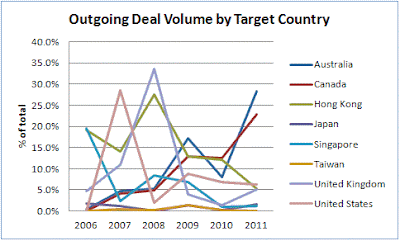

To what extent can we expect these trends to continue? As long as state-owned Chinese companies have a mandate to secure resources, we can expect cross-border mining and oil & gas activity to make up the vast majority of deals. But the massive surge in natural resources focused activity masks other equally important trends.
Friday, October 15, 2010
Strongest quarter for LBOs since the credit crash
 Fundraising is also up this quarter:

Monday, October 11, 2010
Bain's LBO of Gymboree looks like a slam dunk
Monday, October 4, 2010
What Sara Lee tells us about the current LBO environment
About a month ago, KKR allegedly offered to buy Sara Lee for $12B, though Sara Lee's board spurned the buyout firm's advances. It's easy to see why Sara Lee might be an attractive LBO target -- it's not too leveraged, has strong brands and significant opportunities for operational improvements. My analysis (see below) shows that KKR could reasonably expect double-digit returns even if sales growth remains low. So why has KKR not raised its bid or gone hostile?
Given whats happened in the markets we should expect a sharp increase in sponsor activity. The financing market is in great shape and vintage 2005-2008 funds are flush with capital. LBO activity is in fact rebounding as total YTD sponsor backed deals are almost back up to 2005 and 2008 levels. And yet as conditions have improved, we still haven't seen the $10 billion plus mega deals that were the norm before the crisis.
According to Prequin surveys, a majority of LPs are reconsidering their allocation to large PE funds with some notable firms like Blackstone even returning previously paid fees. Now, with PE fundraising still weak, buyout firms are under pressure to prove their mega LBOs generate superior returns and deserve management fees of 1% or higher. The deals done today may prove to be critically important to securing funding in the future.
My analysis below shows that, although Sara Lee is an attractive LBO at $12B, those returns quickly disintegrate as price increases. In fact, price is more important to generating a return (on a percentage basis) than cost of debt or EBITDA growth.
The model below can also be downloaded as an excel file here. The operating model uses historicals to project EBITDA growth and Cash Flow / EBITDA.
Sara Lee Analysis
Monday, September 27, 2010
3G LBO of Burger King
3G's $3.3B ($4.17B total transaction value) LBO of Burger King is one of the most high-profile LBOs of 2010. This LBO is interesting for a number of reasons. For one, the acquirer, investment fund 3G (funded by a small group of Latin American billionaires), is not a part of the usual suspects one would expect to see on a deal of this magnitude. Also different from most LBOs, 3G has stated it is buying Burger King for the long-haul and is willing to wait 10 years before exiting.
The choice of Burger King is also a strange one. When BK was bought out by Bain, GS, and TPG in 2002, Burger King was an insignificant and unappreciated holding of the food and beverage behemoth Diageo, allowing the sponsors to acquire BK at a very favorable valuation. But the Burger King of today is much different. Eight years of sponsor ownership have turned BK into a lean company with few easily realized cost reductions. Furthermore, from a strategic point of view, BK has fallen far behind its rival McDonald's and requires massive amounts of capital expenditures to compete (estimated in a recent Bloomberg article to be as high as $3 billion). For more on the challenges facing 3G, go here. Perhaps most surprising is the valuation. 3G did not pick up BKC on the cheap, paying 9.4x LTM EBITDA and 8x LTM net income.
My model of the LBO is posted below. I suggest you do not try to look at it on Scribd but instead go here, and download the excel file. My analysis shows that using conservative growth assumptions and moderate cost cutting assumptions, the Burger King LBO could return 16% annually if 3G exits in five years at the same valuation (9.4x EV/EBITDA) at which it entered.
However, this return is very sensitive to Burger King's ability to cut costs, which is questionable given the rising costs in the industry as well as BKC's previous ownership (Management also expects SG&A to increase by 3% in 2011). If one assumes Burger King has to boost capex to 10% of sales and SG&A as a % of sales increases by 3%, the 15% IRR quickly disappears, even with above trend top-line growth.
That being said, I actually think this deal was a good idea for 3G if 3G manages to leverage its experience in Latin America to grow Burger King quickly in emerging markets. As Burger King grows internationally, its operating leverage from its restaurant ownership will deliver larger margins and significantly increase Burger King's valuation. But overall, like most recent LBOs, the success of the BKC LBO is heavily dependent on exogenous forces. 3G is blessed to have patient investors. It's longer term investment horizon will allow it to wait for an opportune time to exit -- which can make all the difference.
Burger King LBO Model
Going forward...
As I've learned more about finance over the last few years, I've started to shift my focus from markets and asset prices to transactions and operations. On this blog, I've written mostly on macro, geopolitical, and policy issues. Going forward, I expect to have little to say on these subjects. For one, I (regrettably) no longer have time to read as I once did (I recently graduated from school and am working full-time in finance). But more importantly, I've become increasingly interested in the details of operations, capital structure, and M&A. Perhaps the greatest reason behind this shift is that I've found I really like the way investors can influence returns by making financial or operating changes, while in macro investments an investor is merely a spectator, (though exciting as that may be in interesting times such as these the lack of control can be frustrating).
So what I've decided to do is use this blog as a forum to discuss recent M&A deals (trends, valuation, etc.), focusing mostly on LBOs and private equity activity. I'll usually build a model to back up my analysis which I will post on Scribd. The first LBO I will discuss is 3G's recent buyout of Burger King.
Monday, May 31, 2010
My Thesis: Pricing of LBOs from 1999-2009
I finally finished my honors thesis. I wrote about LBO pricing from 1999 to 2009. LBO prices (valuation multiples) rose dramatically as the amount of capital committed to private equity surged almost 10-fold after 2001. I argue that mega-buyouts, such as TXU Corp., HCA, First Data, and Freescale, were designed to avoid the increasing prices of LBOs by acquiring companies other private equity firms could not buy. My results support this hypothesis and show that after an LBO exceeds around $10 billion in Enterprise Value, the valuation of the deal becomes more favorable. After bypassing this threshold, EV/EBITDA decreases .1-.2 for every $1 billion increase in transaction value. This result is statistically significant at the .05 level.
Sunday, May 9, 2010
A Shift in American Conservatism
Over the last decade, the Republican party has not lived up to its conservative values regarding fiscal issues. Until recently, the far right-wing focused increasingly on social issues. Consider, for example, Bush's gaping budget deficits. Or better yet, the rise of politicians such as Huckabee or Palin, both of whom's appeal is their social conservatism. Both can be described as either uninformed, undistinguished, or both in the fiscal realm. Given recent developments in GOP politics, it seems this trend has finally reversed, though ironically this reversal may not be as good for the deficit as one might expect.
Sunday, April 25, 2010
Grantham on Bubbles
Thursday, April 22, 2010
Kraft-Cadbury Was a Good Deal Despite Recent News
Much ado has been made about the Kraft-Cadbury deal. The consensus seems to be (especially after the overlooked pension shortfall) that Kraft overpaid for Cadbury and, even worse, used its own undervalued stock to do so. Recently, Kraft revealed CEO Irene Rosenfeld's compensation for 2009 was $26.3 million, up 41% from 2008. The compensation committee "heavily weighted the significant effort and the ultimate acquisition of Cadbury" to determine the payment. To some, the Kraft-Cadbury deal is the perfect example of empire building, suggesting that Rosenfeld executed the Cadbury deal to increase revenue (which generally determines CEO compensation) without much attention to the price. This criticism reflects the common conception that most M&A destroys value and is driven by ego and compensation. In my opinion, this view is misguided, both for M&A generally and Kraft specifically.
Sunday, April 18, 2010
A Few Words on the SEC's Suit Against Goldman
Reading the SEC's allegations against Goldman (available here), I was reminded of the case against Bear Stearns hedge fund managers Cioffi and Tannin. From the excerpts of emails given by the prosecution during this case, it seemed that Cioffi and Tannin clearly deceived investors. However, the defense argued that the prosecution's damning quotations had been taken out of context and did not reflect the concrete views of the defendants. Furthermore, it was difficult to link these discussions to actually proving that the managers mislead investors. Cioffi and Tannin were acquitted of any criminal wrongdoing.
Saturday, April 17, 2010
Expect LBOs to Make a Comeback
Friday, April 16, 2010
Russia's Rising Influence in Its Near-Abroad
It seems as if Russian-American relations have improved significantly over the last year. The rhetoric coming out of Russia towards the US has been much milder. Russia has shown increasingly strong support for sanctions against Iran. Most importantly, Obama and Medvedev signed the new START treaty about a week ago in Prague. Perhaps Obama's push to "reset" relations with Russia have worked. However, I doubt that's the case. A country as driven by realpolitik as Russia would never compromise on personal politics alone. A closer look reveals Russia has reason to be accommodating given its strong successes in securing its "near-abroad" over the last year.
Thursday, March 25, 2010
Economic and Market Update with Prof. Spellman
Sunday, March 21, 2010
Perspectives on Chinese Currency Manipulation
Thursday, March 18, 2010
Valuation Matters
It's common sense that equity returns depend on the starting valuation. In other words, mean returns from an asset class mean little for an asset where returns are mostly dependent on capital gains. When capital gains are a significant proportion of total returns, starting valuation should be more important than historical performance. It seems simple and obvious, but most investors who are allocating a long-term portfolio still don't pay enough attention on valuation.